Every buying season someone asks us whether inflatables are "the future". The honest answer is that they are a margin product, not a volume product — and treating them as interchangeable with pole tents is the fastest way to disappoint both your accountant and your customers.
How the two structures actually differ
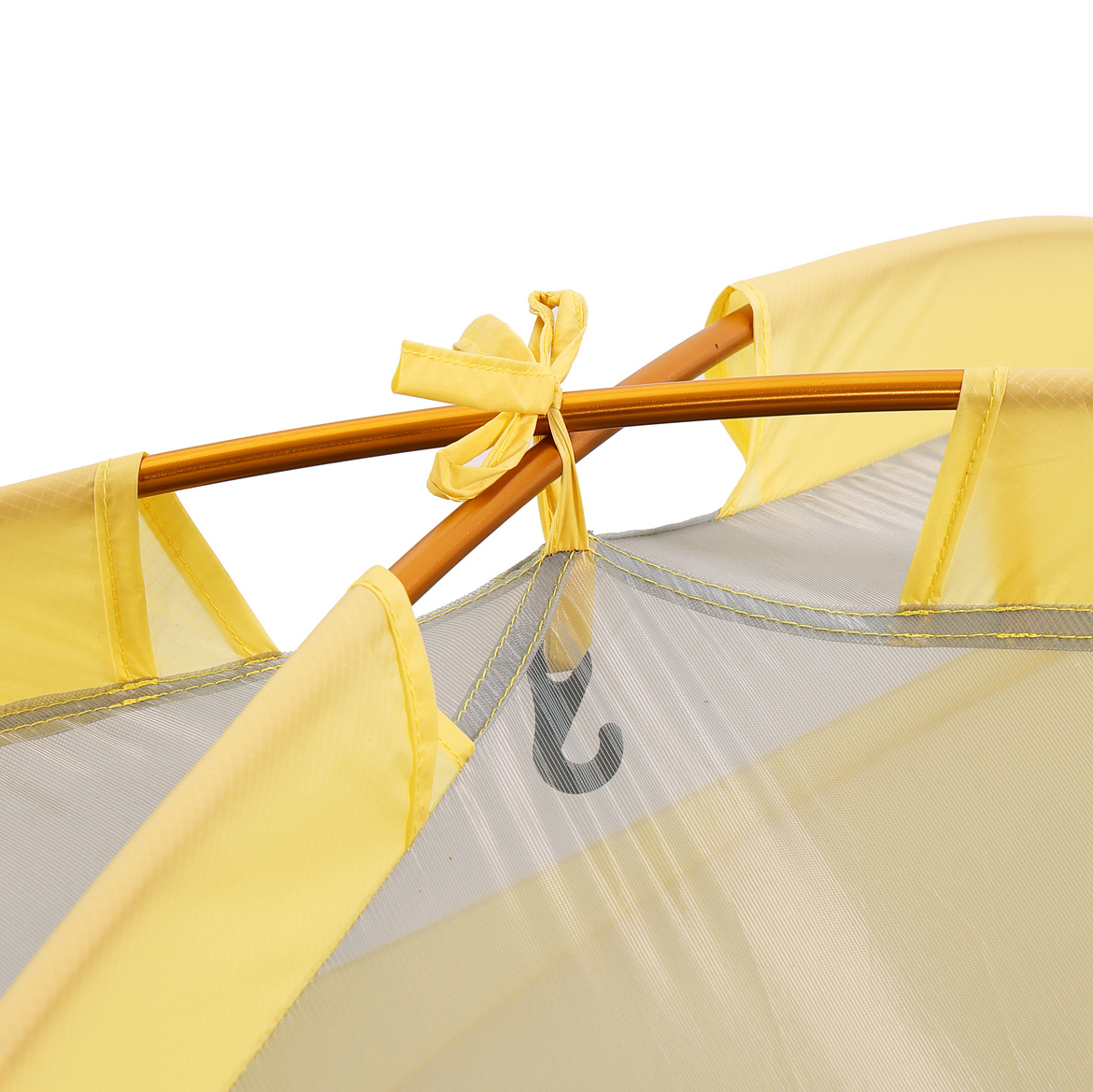
An inflatable replaces its pole set with inflated TPU or PVC bladders inside a fabric sleeve. That single change drives almost every downstream difference: packaging, weight, price, and — the part that shows up in your returns data — repair behaviour.
| Pitch time (2 people) | Air: 3–6 min | Pole: 8–20 min |
|---|---|
| Unit cost, same size | Air runs roughly 1.6–2.2× a pole equivalent |
| Pack volume | Air is bulkier — fewer units per container |
| Failure mode | Pole: breaks at a joint. Air: puncture or valve leak |
| Field repairability | Poles: swap a section. Air: patch or replace a bladder |
| Retail positioning | Air = premium family. Pole = mass-market workhorse |
The margin story
Inflatables cost more to buy and more to ship, and they still command a higher retail price — that is the appeal. A 5-person inflatable that lands at roughly 1.8× the FOB price of a comparable pole tent routinely retails at 2.2–2.6×, because the customer is buying minutes and a story, not square metres.
The warranty story nobody puts on the box
Pole tents fail in ways customers understand: a fibreglass section snaps, a shock-cord goes, and a €6 spare part fixes it. Inflatables fail in ways that feel like a defect even when they are not — a slow leak at a valve, a bladder abraded by its own sleeve. Two mitigations make the difference between a manageable returns rate and a brand problem:
- Quality bladders and valves. Specify welded TPU bladders with a proven valve, not the cheapest sealed-air option. This is the single biggest quality lever.
- Ships-with repair kit and a spare-bladder SKU. Offering spare bladders as a part turns a warranty claim into a repeat purchase.
We also recommend a pump with a pressure gauge and a printed max-PSU label. Over-inflation on a hot afternoon is the most common cause of preventable damage we see.
Logistics and the shelf-space question
In-store, inflatables need floor space to demo — a folded pole tent tells no story, but an inflated one sells itself in about ninety seconds. If you sell primarily online, the demo advantage disappears and the freight penalty stays. That is why the split we recommend to most mid-size retailers is:
- 70–80% of SKU count: pole and pop-up. These carry the volume, the margin stability and the easy shipping.
- 20–30%: a small inflatable hero range. Two to four models — a family cabin air tent, a two-bedroom layout, maybe a large-format one for glamping-adjacent buyers.
What is changing for 2027
Three things are moving in the air-beam category that are worth planning around:
- Bladder cost is coming down as TPU supply matures, narrowing the price gap at the entry end.
- Hybrid frames — air beams for the main arch plus short pole sections for bedroom dividers — are reducing pack volume and improving wind behaviour.
- Accessory ecosystems (awnings, inner bedrooms, footprints that zip on) are turning one inflatable into a multi-SKU attachment programme, which is where the real lifetime margin lives.
Our recommendation
If you already sell family camping successfully, add one or two inflatables as a premium anchor, sourced from a supplier who will stand behind the bladders, and keep the core of the range on poles. If you are entering the market fresh, start on poles — you will learn your customer faster and your cash will not be sitting in a container of air.
Compare an air tent and a pole tent side by side
Our inflatable range starts at a 3–4 person cabin layout and goes up to a 12–14 person multi-room unit. Ask for a matched quote against any pole model in your range and we will show you the landed-cost difference.
Browse inflatable tents